Wednesday, November 20, 2013

Race Disciplines - Paddling 1

When preparing for an Adventure Race, it is important to pay attention to any information one can find about the course ahead of time.

The 2014 R3 Shenandoah Epic Adventure Race website gives some basic clues about race composition in the thin description below.  The bread and butter disciplines are all there with paddling, biking and orienteering (trekking with nav).

Description: This years race will feature a long paddle to start the race, a day time orienteering course, a day time mtb course followed by a rogain style night course with biking and a night orienteering course.

As for the percentages spent at each discipline, we can only guess. An important question is what, in the Race Director's mind, constitutes a "long paddle". We will be looking to previous race descriptions to see what this RD likes to put together as well as reading the race reports for how the racers felt about old courses.  RDs often take feedback from previous years in consideration when designing a course.

Here is a plausible breakdown, focusing on the paddling slice of the pie.  It would not be unheard of to put 6 to 8 hours of paddling at the front end of a race.  It is however unlikely that the boats will be waiting for teams by the waterside, ready to go at the start of the race.  It is all too tempting to send racers over a mountain pass while carrying their canoe and extra gear for good measure.
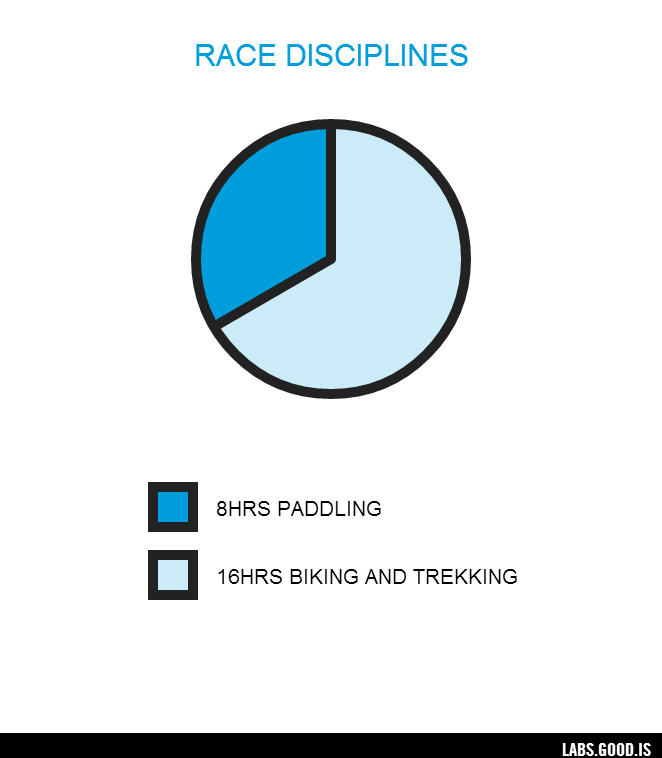

At any rate, "long paddle" means putting in a solid slice of training either directly paddling a canoe or other vessel, or at least putting a few hours/week in on a rowing machine.

We will be recommending exercises in the training plan for specifically building paddling strength and endurance.  Pecs, lats, shoulders, triceps, biceps and core/torso exercises are a staple.

Tuesday, November 19, 2013

Training Plan V1.0 - Broad Strokes

April 26th seems a long way off but will be here before you know it.  Given an aggressive start date of December 1st, there are just over 5 months of preparation time until the R3 Shenandoah Epic Adventure Race.

Further broken down, it can be seen as

4 weeks of base training
14 weeks of race specific training broken into 4 build phases.
2 weeks of tapering
Go Time.

Below are the broad strokes of a training plan that has produced excellent results in the past when races are combined with *long things*.  We'll paint in the details as we get closer and get everyone's buy in.

The basic principles are:

1. Begin by developing a broad base of skills and fitness.  This phase lasts 4 weeks and is used to knock the dust off of rusty joints and muscles and get basically familiar with the disciplines at hand.  It's a great time to get in some light biking, running and paddling (or row machining).  It is also a crucial time to start building up a strong core that will serve as the foundation for all further fitness.  Whole body fitness is the name of the game here.

2. Increase intensity and endurance in mini-Build Phases lasting from 2 - 3 weeks.  Build weeks will increase the number of training hours by ~ 10% week to week.  In the early months, these will be stacked with three weeks of increases.  Later on when the long workouts are of a more epic nature, they will be stacked in two week blocks.

3. Built-in recovery weeks.  The recovery week at the end of each build cycle will be a chance for the body to deeply recover from the increased demands over the past few weeks. They are a great time to work on soft skills and details such as map work and general race planning.

4. Taper.  Reduce volume (but not intensity) for the last two weeks before race time.  This is a period for the body to fully recover from the demands of the training season and to show up on race day in peak physical and mental condition

5. Race. - nuff' said.

6. Recover and Reflect.  - A period of focused recovery.  The race took its toll, now is time to take deliberate daily steps towards recuperating and taking care of any aches/pains/injuries that have cropped up.  This is also time to review the experience, analyze race performance, document the techniques that worked well and note the areas in need of improvement.  Win, lose or draw, this is the time to rock back in a comfortable chair with a good scotch and stogie to rehash the stories that will be told for years to come.


Mon Tue Wed Thur Fri Sat Sun Weekly Notes
Week 1 12/02 12/08


Base 1
Week 2 12/09 12/15


Base 2
Week 3 12/16 12/22


Base 3
Week 4 12/23 12/29


Base 4
Week 5 12/30 01/05


Build 1-1
Week 6 01/06 01/12


Build 1-2
Week 7 01/13 01/19


Build 1-3
Week 8 01/20 01/26


Recovery 1
Week 9 01/27 02/02


Build 2-1
Week 10 02/03 02/09


Build 2-2
Week 11 02/10 02/16


Build 2-3
Week 12 02/17 02/23


Recovery 2
Week 13 02/24 03/02


Build 3-1
Week 14 03/03 03/09


Build 3 -2 (Epic)
Week 15 03/10 03/16


Recovery 3
Week 16 03/17 03/23


Build 4-1
Week 17 03/24 03/30


Build 4-2 (Epic)
Week 18 03/31 04/06


Recovery 4
Week 19 04/07 04/13


Taper 1
Week 20 04/14 04/20


Taper 2
Week 21 04/21 04/27


Travel In Check-in Race 1 Race 2 Race
Week 22 04/28 05/04 Travel Out


Deep Recover
Week 23 05/05 05/11


Reverse Taper 1
Week 24 05/12 05/18


Reverse Taper 2

An Open Letter 2013-11-12


APRIL 25th-27th, 2014

Hi Gents,

Below is a link to the Shenandoah Epic AR in April.

For full disclosure, before I can officially extend the offer to join, I have to talk it through with my co-chair of Kaizen AR Team, Jason Smith.  Please don't be offended by the formality.  Where we're going there is no room for hurt feelings and we may want to have a meetup to discuss as a group. 

Take a look, do some soul searching and see if you are interested.  Then take a week or two and think it over again before deciding.  Mind you that this decision is all too easy to make sitting at a computer in the comfort of your dry warm home with a full belly, rested muscles, no blisters on your feed and following a good night's sleep These will not be the conditions of this race.

Committing to this venture means that each of us (and our families) will be making non-trivial sacrifices of time and energy to prepare our minds and bodies.  To be certain, there will be some slice of your current life that you will be missing out on over the next 4-5 months.  Carefully consider if you'll really have time for consistent weekly training and building to "Epic training" 5+ hour sessions every couple of weeks.  Making the commitment to yourself and the group, only to pull out later, can have seriously demoralizing effects.  Of course, no one would be faulted for pulling out because of injury, death in the family or other similar serious event.

My last disclaimer is that like many extreme endurance events, the training is where you'll find the most fun.  Comparing progress with teammates, planning for the event, building a new body temple and developing or honing new skills is supremely satisfying.  I wouldn't categorize the actual racing as "fun" no more than Lance Armstrong would call an important Tour De France time trial as fun.  Rather it is an event of supreme focus, maximizing efficiency of locomotion, head work, selflessness and managing the group dynamic to finish as a team much faster than any one person could accomplish on their own.  Together, we will be far stronger and faster than our weakest link, and at different times, we will all be the weak link.

 Hagberg Out.