Friday, December 27, 2013

Adventure Race Preparation - Base Training Closing, Starting the Build

Base training phase is quickly coming to an end for REV3 Shenandoah Epic 26hr Adventure Race.  Hit some good workouts, missed some and supplemented others.

Jan will introduce more specific training to AR and will be last month of heavy lifting in the gym. February will bring more "functional lifting".  Sandbags anyone?!

Still going strong with the daily mile.

I've just heard about something wonderfully awful called cold shower therapy.  Today I fell down the internet hole of trying to identify the perfect AR backpack even though I have more packs than I'd care to admit that would probably get the job done just fine.

Note, the below schedule only lists focused workouts.  I will be running at least a mile a day and possibly bike commuting to work (if I can work up the moxie to fight traffic again in a #NarrowMarginsDumbPeopleSmartPhone era).


12/27/2013 – Build 1.0


Mon Tue Wed Thur Fri Sat Sun Weekly Notes
Week 4 12/23 12/29 Lift Heavy
Push
Legs
Plankathon
Lift Heavy
Pull
Legs
Abs
Ride 20 min Lift Heavy
Push
Legs
Plankathon
Lift Heavy
Pull
Legs
Abs
Walk 15 min
20 - 30 lb pack
6 Base 4
Week 5 12/30 01/05 Ride 45 min
Heavy Push
Plankathon
Row 20 min
Heavy Pull
Core
rest Ride 30 min
Row 20 min
rest 2.5 hr trek rest Build 1-1
Week 6 01/06 01/12 50 min cardio rest Ride 45 min
Heavy Push
Plankathon
Row 25 min
Heavy Pull
Core
rest 3 hr bike
30 min trek
rest Build 1-2
Week 7 01/13 01/19 50 min cardio rest Ride 20 min
Heavy Push
Plankathon
Row 30 min
Heavy Pull
Core
rest 4 hr night ops rest Build 1-3
Week 8 01/20 01/26 2 mi rec jog
Long stretch
rest Swim 1 hr 5 mi rec jog rest Skills or X-Train rest Recovery 1

Sunday, December 22, 2013

Map Exercise - Folding, Orienting and Thumbing


In a previous post, I discussed the basic principles of folding, orienting and thumbing a map. Here is an easy and fun exercise for practicing those skills.

One of my go-to moves on short time is to pull up Google Maps, zoom down to an area I want to work in, screenshot and print on a standard sheet of printer paper.  It doesn't have to be pretty, just something good enough to see the features you'll be looking for.

Once you have a map to work with, spend a few minutes finding 10 - 12 interesting features and circle them with a pen.  Features for this type of training should be big and obvious.  An intersection of two roads, the end of a fence line, the corner of a wooded area.

With map at the ready, head out to your course.  Fold the map so that at least the start position and first feature are visible.  Hold your map horizontally (parallel to the ground) and orient your map using the features around you (N on paper points to N in real world).  Place your thumb on the map at your current location and begin your movement.  Update your thumb position frequently.  I use roughly 100m as a maximum distance to travel before updating my thumb position when traveling on foot.  When training, I try to do it more frequently just to form the habit, walking my thumb across the map.  Refold the map whenever necessary and be sure to always keep it oriented to your surroundings.

There are endless possibilities for modifying this exercise.  Have fun with it!


Note: Below is a map of a recent navigation practice session.  This took less than 5 minutes at the computer including printing and I was out the door for an hour of bliss scampering around on a powerline trail and in a local neighborhood.
Training Notes: Printed map, circled some features to "find", loaded up a heavy(ish) pack and went out for a Nav practice session.

Feature based navigation, no compass work.

Workout Focus: Folding, Thumbing and Orienting map.  Also observing world then matching to map.
Start Time: 21:00
Duration: 57 mins
Distance Covered: 3.24 mi
Weather: 25 degrees F / -3.9 C, Clear Skies
Notes: 30lb pack, stamped through a couple of puddles and set out.

Friday, December 20, 2013

Adventure Race Training - Walking Heavy

What does 1) an 80lb Heavy Bag,  2) 30lb kettle-bell and 3) a backpack have in common?

Answer: Adventure Race Training!

Saturday, December 14, 2013

Navigation Training - Folding, Orienting and Thumbing a Map


Lately, I've been pouring over navigation club articles,  military navigational course materials and Adventure Race guides as a refresher for navigating successfully with a map.  Most sources start with the three basic tenants of map work.  They are, folding a map, orienting the map and staying found.

Folding a Map.  Most maps are much larger than can be easily carried and manipulated while in motion.  By folding a map down to a manageable size, it is not only easier to work with, but there is much less information being shown at a time.  This makes it easier to keep track of where you are on the map.  A good rule of thumb is to fold a map down to an easily manageable size that still depicts where you are in the field as well as your next couple of objectives.

Orienting the Map.  Most people learned to use maps in a classic "North Up" position.  This is all well and good when doing the planning phase of navigation but when using the map to execute a plan and actually get somewhere, this is not the best technique.  If you are walking South while looking at a map in the North Up orientation, everything you see in the field is opposite of its representation on the map.  You have to mentally reverse directions when moving from the map to the field and vice versa.  This can become exceedingly challenging when dealing with winding trails and gets even worse as mental fatigue sets in.  It is much more effective to orient the paper map so that the cardinal directions on the map match up with those directions in the real world.  The GPS in your car or phone probably already does this for you.  If you're following down a stream on your map and want to take a left fork, look up and the fork will be to your.... left!  Consider making this decision at 3am after 12+ hours of racing or hiking and it's a no-brainer.

Staying Found - Thumbing a Map. Knowing where you are on your map is all important.  If you don't know where you are, fat chance you're going to be able to figure out how to get where want to go.  Unless that doesn't matter...
Cat: Where are you going?
Alice: Which way should I go?
Cat: That depends on where you are going.
Alice: I don’t know.
Cat: Then it doesn’t matter which way you go.”
― Lewis Carroll, Alice in Wonderland
One great way to stay found is to thumb your map.  The concept of thumbing is quite simple.  Find your position on the map and put your thumb just under that spot.  As you move through the terrain, update your thumb position on the map to match your real world position.  Anytime you need to consult your map, you'll know right where you are (or very close) at a glance.

Click HERE for a Map Exercise to Practice these Skills.


Tuesday, December 10, 2013

Integrating Training into Your Lifestyle - Caveman Example

Preparing for the Rev3 Shenandoah Epic AR takes a non-trivial amount of time out of each week.  Where can we find all this time to get in all of our key workouts among existing work, family and home responsibilities?  Our caveman ancestors may have an answer to this quandary.
In following article, Grant Killian, founder of Untamed Adventure, explores the concept of incorporating training into one's daily lifestyle as opposed to just adding it as a stand-alone element in the daily routine.

The difference between these two tactics might not be obvious but is significant.  Cavemen traveled places by foot and carried loads with their bodies instead of in a car.  Rather than establishing a routine of going to the gym and biking for an hour over lunch, how about using a bicycle for the work commute a few days a week.  An alternative would be biking to the gym for another type of workout session, or biking to the grocery store with a backpack and carrying home groceries.  Have a weekend outing planned with family or friends?  Carry all the water, snacks and maybe a dumbbell in a backpack for good measure for the day.  It's a 2 for 1 deal and no one misses out on time with you.  The more one can incorporate this type of activity into their lifestyle, the less time you'll need to take away from other obligations to "train".


You can read Grant's full article here.  Check it out!

http://explorecompetelive.com/cavemen-the-ultimate-adventure-racers/


Monday, December 9, 2013

REV3 Epic Adventure Race - Promo Video

Below is an excellent promo video for the Rev3 Shenandoah Epic Adventure Race.

I was surprised to see how much carnage there was on the canoe section.  It looks like they were paddling some class II+ rapids in canoes meant for lazy lake paddling (not much rocker, low gunwales) and going right down the meat of the rapids.  Lots of canoes and kayaks dumped.

This is a good reminder that race directors often ensure everyone has wet feet at the beginning of the race to level the playing field.  Keeping dry feet is of course desirable but not very realistic.  It is a good idea to introduce our dogs to wet walking/hiking long before April. 


First Week of Base Training - Done.

First week of base training is in the bag.


activity # timemiles
  Weight Training3 3:00:00
  Running7 1:28:30 8.6(10:18)
  walk/hike2 48:00 2.3(20:52)
  Total10 5:16:30 10.9
averages - sleep:7.6 weight:160.7lbs

Friday, December 6, 2013

How to Find Your Way: Navigate on Trail Using Orienteering Skills


Today I came across a good article by Rebecca Jensen pitching Orienteering skills to Hikers.  Short, sweet and answers the basic question of why to participate in Orienteering events and how it can help your general navigation abilities. 

"Could you be better with map and compass? Take a new look at navigation through orienteering, a navigation sport that can help you find your way anywhere. Wasington Trails Association member, volunteer and Cascade Orienteering Club board member Rebecca Jensen helps you find your way."

http://www.wta.org/hiking-info/basics/how-to/navigate-on-trail-using-orienteering-skills-map-compass

Check it out!

Monday, December 2, 2013

First Day of Base Training is in the Bag.

Monday Dec 2 

7 AM
Running 12:10 [1] 1.1 mi (11:04 / mi)
slept:8.0 weight:160lbs (sick) shoes: Inov8 RocLite 280
Nice easy jog with Bethany this morning.
12 PM
Weight Training (Heavy - Push) 1:00:00 [4]
weight:160lbs (sick) shoes: Merrell Trail Glove

Met Bethany and Jason at the Northside YMCA over lunch.

Warm up shot basketball, arm circles, messing around in gym 15 mins

Bench Press - Warmup, 3 sets x 115 lbs
Fly Machine - 3 sets x 90 lbs
DB Shoulder Press - 3 sets x 30 lbs each arm
Dips - 3 sets
DB Overhead Triceps Extensions - 3 sets x 20 lbs, each arm
Legs - Squat Rack - warm up 20 reps x 95 lbs, 3 sets x 135 lbs
Legs - Calf Raises - 1 set of 10 each leg
Plankathon - 30s front, 30s rside, 30s front, 30s lside, 30s front (no rest)

Sunday, December 1, 2013

December is upon us! - Building a foundation one block at a time.

January 2nd will mark the official start of training for the Rev3 Shenandoah Epic AR in April.

December 2nd is perhaps more important because it is the start of a base fitness foundation upon which the rest of training will be supported.  It can be seen as a sneak attack on Jan 2nd that will help greatly in injury prevention.

The Month of December will be used to build up a foundation of functional fitness, strengthen connective tissue, build up our feet and get re-introduced to (biking) and (walking with a pack).  It's also a time to get into the habit of training as we move through the holiday season.

Below are simplified guidelines that I will be following for December.  For full disclosure, I'll also be running at least a mile everyday for this month.  A more detailed description of the exercises can be found below the chart.

12/01/2013 – Base Phase


Mon Tue Wed Thur Fri Sat Sun Weekly Notes
Week 1 12/02 12/08 Lift Heavy
Push
Legs
Plankathon
Lift Heavy
Pull
Legs
Abs
Ride 20 min Lift Heavy
Push
Legs
Plankathon
Lift Heavy
Pull
Legs
Abs
Walk 15 min
20 - 30 lb pack
Rest Base 1
Week 2 12/09 12/15 Lift Heavy
Push
Legs
Plankathon
Lift Heavy
Pull
Legs
Abs
Ride 20 min Lift Heavy
Push
Legs
Plankathon
Lift Heavy
Pull
Legs
Abs
Walk 15 min
20 - 30 lb pack
Rest Base 2
Week 3 12/16 12/22 Lift Heavy
Push
Legs
Plankathon
Lift Heavy
Pull
Legs
Abs
Ride 20 min Lift Heavy
Push
Legs
Plankathon
Lift Heavy
Pull
Legs
Abs
Walk 15 min
20 - 30 lb pack
Rest Base 3
Week 4 12/23 12/29 Lift Heavy
Push
Legs
Plankathon
Lift Heavy
Pull
Legs
Abs
Ride 20 min Lift Heavy
Push
Legs
Plankathon
Lift Heavy
Pull
Legs
Abs
Walk 20 min
20 - 30 lb pack
Rest Base 4

Lift Heavy
  • Using a combination of free weights and fitness machines
  • Performing 3 sets each exercise at a weight suitable for 6 - 8 reps per set
  • Starting with largest muscle groups first, moving to smaller muscle groups
  • Supreme focus on correct form.  If you can't get an extra rep using proper form, then leave it. This is not the time to risk injury or form bad habits.

Push Days I
Warm up with 10 min push-ups, arm circles, medicine ball tosses, etc...
Focus on muscles that push away from the body.
Bench Press
Fly Machine or DB Flies
DB Shoulder Press
Dips
Triceps Extensions
Legs - Squat Rack (warm up with 20 reps, bare bar)
Legs - Leg Extensions
Legs - Calf Raises
Plankathon - 30s front, 30s rside, 30s front, 30s lside, 30s front (no rest)

Push Days II - (to be done 2nd 1/2 of base training, or to just change it up)
Warm up with 10 mins activity to get the blood flowing
Incline Bench Press
Straight Arm DB Pullover
Decline Bench Press
Cable Crossovers
Dips
Alternating Front and Lateral Straight Arm DB Raises (side & front = 1 rep)
Rope Grip Cable Tricep Push Downs
Legs - Goblet Squats
Legs - Lunge Matrix
Abs - 6" Straight Leg Wide-Togethers with Quick Heel Touch on Ground.
Abs - Knees up Crunches
Plankathon

Pull Days I
Warm up with 10 min Sisyphus, elliptical, calisthenics, etc...
Back Extensions
DB Back Flies
DB Lawnmower pull
Pullups or Lat Pulldowns
Seated Rows
DB Curls
Legs - Front and Lateral Lunges (unweighted)
Legs - Hamstring Curls
Abs - Legs in air crunches
Abs - Reverse crunches
Abs - Oblique V-ups
Abs - Leg Climbers

Pull Days II - (to be done 2nd 1/2 of base training, or to just change it up)
Wide Grip Pull-ups
Close Grip Pull-ups
Reverse Grip Pull-ups
V Grip Cable Pull down
Seated Cable Row
Back Extensions
Barbell Bicep Curls
DB Preacher Curls
Concentration Curls
Abs - Bicycles (20 each way)
Abs - In & Outs
Abs - Sit-up, Rotate and Touch Opposite Hand to Foot or Leg
Abs - Oblique V-ups


Riding
This can be riding anything that has an actual bicycle style saddle.  Spin bike, Exercise bike, road bike, mountain bike, unicycle.  Just get those legs spinning for the designated time.

Walking with Pack
Put some heavy stuff in a pack and just get walking at a brisk but not uncomfortable pace.  This is more about time spent on feet rather than distance.  Walk on varied terrain, soft and hard, up and down. I've wrapped a 30 lb kettle bell in a few old towels and stuck it in my pack.  Water bottles are another option.  3.2 mph or between 17 and 18 min / mile seems to be my sweet spot for pace.

That's it!  Enjoy the next 4 weeks.

Wednesday, November 20, 2013

Race Disciplines - Paddling 1

When preparing for an Adventure Race, it is important to pay attention to any information one can find about the course ahead of time.

The 2014 R3 Shenandoah Epic Adventure Race website gives some basic clues about race composition in the thin description below.  The bread and butter disciplines are all there with paddling, biking and orienteering (trekking with nav).

Description: This years race will feature a long paddle to start the race, a day time orienteering course, a day time mtb course followed by a rogain style night course with biking and a night orienteering course.

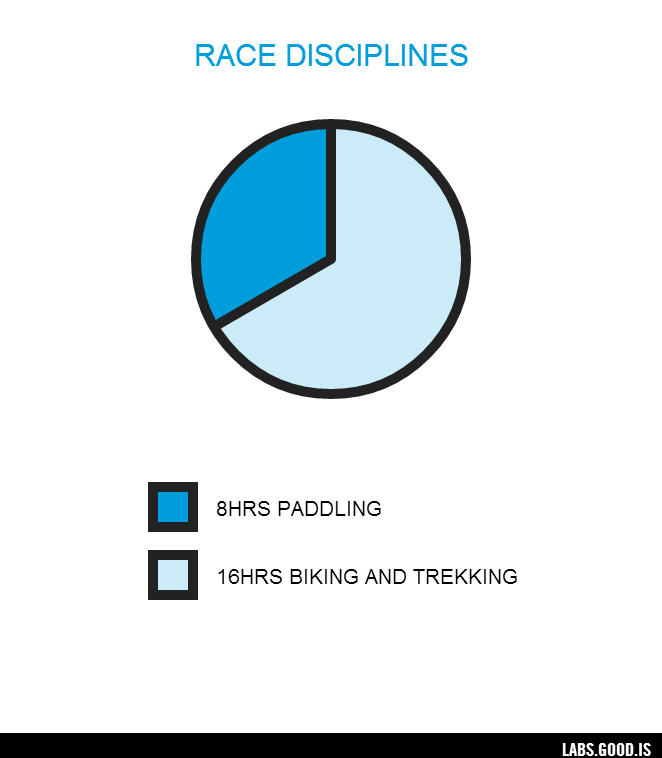
As for the percentages spent at each discipline, we can only guess. An important question is what, in the Race Director's mind, constitutes a "long paddle". We will be looking to previous race descriptions to see what this RD likes to put together as well as reading the race reports for how the racers felt about old courses.  RDs often take feedback from previous years in consideration when designing a course.

Here is a plausible breakdown, focusing on the paddling slice of the pie.  It would not be unheard of to put 6 to 8 hours of paddling at the front end of a race.  It is however unlikely that the boats will be waiting for teams by the waterside, ready to go at the start of the race.  It is all too tempting to send racers over a mountain pass while carrying their canoe and extra gear for good measure.


At any rate, "long paddle" means putting in a solid slice of training either directly paddling a canoe or other vessel, or at least putting a few hours/week in on a rowing machine.

We will be recommending exercises in the training plan for specifically building paddling strength and endurance.  Pecs, lats, shoulders, triceps, biceps and core/torso exercises are a staple.

Tuesday, November 19, 2013

Training Plan V1.0 - Broad Strokes

April 26th seems a long way off but will be here before you know it.  Given an aggressive start date of December 1st, there are just over 5 months of preparation time until the R3 Shenandoah Epic Adventure Race.

Further broken down, it can be seen as

4 weeks of base training
14 weeks of race specific training broken into 4 build phases.
2 weeks of tapering
Go Time.

Below are the broad strokes of a training plan that has produced excellent results in the past when races are combined with *long things*.  We'll paint in the details as we get closer and get everyone's buy in.

The basic principles are:

1. Begin by developing a broad base of skills and fitness.  This phase lasts 4 weeks and is used to knock the dust off of rusty joints and muscles and get basically familiar with the disciplines at hand.  It's a great time to get in some light biking, running and paddling (or row machining).  It is also a crucial time to start building up a strong core that will serve as the foundation for all further fitness.  Whole body fitness is the name of the game here.

2. Increase intensity and endurance in mini-Build Phases lasting from 2 - 3 weeks.  Build weeks will increase the number of training hours by ~ 10% week to week.  In the early months, these will be stacked with three weeks of increases.  Later on when the long workouts are of a more epic nature, they will be stacked in two week blocks.

3. Built-in recovery weeks.  The recovery week at the end of each build cycle will be a chance for the body to deeply recover from the increased demands over the past few weeks. They are a great time to work on soft skills and details such as map work and general race planning.

4. Taper.  Reduce volume (but not intensity) for the last two weeks before race time.  This is a period for the body to fully recover from the demands of the training season and to show up on race day in peak physical and mental condition

5. Race. - nuff' said.

6. Recover and Reflect.  - A period of focused recovery.  The race took its toll, now is time to take deliberate daily steps towards recuperating and taking care of any aches/pains/injuries that have cropped up.  This is also time to review the experience, analyze race performance, document the techniques that worked well and note the areas in need of improvement.  Win, lose or draw, this is the time to rock back in a comfortable chair with a good scotch and stogie to rehash the stories that will be told for years to come.


Mon Tue Wed Thur Fri Sat Sun Weekly Notes
Week 1 12/02 12/08


Base 1
Week 2 12/09 12/15


Base 2
Week 3 12/16 12/22


Base 3
Week 4 12/23 12/29


Base 4
Week 5 12/30 01/05


Build 1-1
Week 6 01/06 01/12


Build 1-2
Week 7 01/13 01/19


Build 1-3
Week 8 01/20 01/26


Recovery 1
Week 9 01/27 02/02


Build 2-1
Week 10 02/03 02/09


Build 2-2
Week 11 02/10 02/16


Build 2-3
Week 12 02/17 02/23


Recovery 2
Week 13 02/24 03/02


Build 3-1
Week 14 03/03 03/09


Build 3 -2 (Epic)
Week 15 03/10 03/16


Recovery 3
Week 16 03/17 03/23


Build 4-1
Week 17 03/24 03/30


Build 4-2 (Epic)
Week 18 03/31 04/06


Recovery 4
Week 19 04/07 04/13


Taper 1
Week 20 04/14 04/20


Taper 2
Week 21 04/21 04/27


Travel In Check-in Race 1 Race 2 Race
Week 22 04/28 05/04 Travel Out


Deep Recover
Week 23 05/05 05/11


Reverse Taper 1
Week 24 05/12 05/18


Reverse Taper 2

An Open Letter 2013-11-12


APRIL 25th-27th, 2014

Hi Gents,

Below is a link to the Shenandoah Epic AR in April.

For full disclosure, before I can officially extend the offer to join, I have to talk it through with my co-chair of Kaizen AR Team, Jason Smith.  Please don't be offended by the formality.  Where we're going there is no room for hurt feelings and we may want to have a meetup to discuss as a group. 

Take a look, do some soul searching and see if you are interested.  Then take a week or two and think it over again before deciding.  Mind you that this decision is all too easy to make sitting at a computer in the comfort of your dry warm home with a full belly, rested muscles, no blisters on your feed and following a good night's sleep These will not be the conditions of this race.

Committing to this venture means that each of us (and our families) will be making non-trivial sacrifices of time and energy to prepare our minds and bodies.  To be certain, there will be some slice of your current life that you will be missing out on over the next 4-5 months.  Carefully consider if you'll really have time for consistent weekly training and building to "Epic training" 5+ hour sessions every couple of weeks.  Making the commitment to yourself and the group, only to pull out later, can have seriously demoralizing effects.  Of course, no one would be faulted for pulling out because of injury, death in the family or other similar serious event.

My last disclaimer is that like many extreme endurance events, the training is where you'll find the most fun.  Comparing progress with teammates, planning for the event, building a new body temple and developing or honing new skills is supremely satisfying.  I wouldn't categorize the actual racing as "fun" no more than Lance Armstrong would call an important Tour De France time trial as fun.  Rather it is an event of supreme focus, maximizing efficiency of locomotion, head work, selflessness and managing the group dynamic to finish as a team much faster than any one person could accomplish on their own.  Together, we will be far stronger and faster than our weakest link, and at different times, we will all be the weak link.

 Hagberg Out.

Monday, January 21, 2013

Training - 2ish hours of Trekking in Richmond

With a week of rain and snow in Richmond, the local trails were far too mushy to entertain any serious mountain biking efforts this weekend. Ok, we're going to need lots more time on our feet anyway. Failing to nail down a plan the night before, we ended with Jason going to meet at my house at 7 am and we'd wing it.  This is where Google Maps comes in handy. I came downstairs at 6:30a and over a cup of coffee threw down 15 way points around the River in Downtown Richmond to include:
and a few token silly activities to complete along the way.


View Downtown Trek in a larger map

We began at Tredegar Street parking lot, under the railroad tracks.  The only real decision to make in this last second course was which way to go round.  We decided clockwise and headed up the hill to our first checkpoint at the WWII Memorial.  Our mission was to find and write down names of soldiers who matched our first and last initials.  This was pretty easy since they're listed alphabetically but hey, was worth the hill climb to get warmed up.

Next we headed across the footbridge to Belle Island for CP 2, the rock skipping challenge at the South end of Belle Isle.  We quickly discovered that the whole South end of the island is heavily vegitated and mucky, with nary a skipping rock to be found.  Eager to get our heartbeats up and legs moving we decided to let this one slide and head over to the old hydroelectric plant  The CP3 challenge was supposed to be to crawl into the open reservoir and retrieve some trash form the cistern.  With a high river, this thing was full of water, rather than its usual mostly dry state.  Foiled again.  We crossed the footbridge to the South side of the James, headed West to the stairs up to riverside drive.  Here we took a couple of laps up and down.

At the top, Jason spotted a playground with fitness trail and suggested we go do an impromptu workout therein.  We jogged over and went round the course.  It was really designed for the geriatric crowd with lots of exercises for the kind of basic balance and strength needed for fall avoidance.  We made the most of it but probably got more out of the quotes we read off of each station.

CP 4 and 5 were to climb up on some old bridge pillars by the Manchester Bridge climbing area and strike a pose.  Our handiwork can be seen below.


We headed under Manchester Bridge to the flood wall walk.  The James was really pumping today and we stopped to snag a few pics of the high water.


Checkpoint 6 was to place a small trinket behind a bush on the way out to Ancarrow's Landing via the Richmond Slave Trail.  I forgot to bring a trinket in the morning rush but ran over to said bush and faked it for good measure.  I must say that bush looked more impressive from space when the shot must have been taken in Summer.

Out at the landing we bagged CP 7 by snapping a shot of the Boathouse Restaurant across at Rocket's Landing.


The next few CPs were along the trail leading back.  They included climbing down under a small bridge, dipping some water out of the James from under the I-95 Bridge and heading back along the boulder field. HERE is where we found "Chuck".  Chuck was an old railroad tie that had been beaten up by the river and lot most (but not all) of his heft.  We decided he looked lonely and needed to be transported the 2.5 miles back to our car.  

Soon after picking up our little friend we did a time check. *shit*, we're never going to make it back by our 9:30 cutoff time.  Time to take the direct route back to Tredegar. We humped it across Manchester Bridge, skipping CP 11 (kick a cell tower on Mayo Island) passing Chuck back and forth when we'd had our fill.   

We dipped down onto the Pipeline trail behind a couple of Joggers.  They graciously let us pass stating that "People carrying logs have the right of way".  Trotting down the trail, we both noticed the impressive height of the river and that areas that usually sported sandy beaches were well under water.  Below is a picture of Jason w/ Chuck.


I didn't snap a picture but if you look left from the pipeline trail, you can see a small Island that is a designated Heron Rookery.  Apparently Great Blue Herons were almost non-existent in this area due to pollution in the James River corridor.  The last 20 years has seen great improvements in the James River water quality and now over 40 Heron's use this island as their nesting ground.  As a testament to these positive changes, I see a Heron nearly every time I ride or run down around the James River Park System. Today was no exception as we bagged CP 12 by seeing dozens of Herons up in the trees.


 The pipeline trail consists at first of a steel walkway, built over top of a large drainage pipe. As you traverse it East -> West, it degrades into just some concrete poured atop the pipe.  Finally the pipe goes underground at the end... wait... I meant under water? Yep, the trail was flooded for the last 40 yards to the trees.  Rather than adding on the extra mile by backtracking, we decided to try our luck with the submerged trail. The current was strong enough that even sideways, the only way to make forward progress was to heel-toe wiggle our lead foot forward until we had enough room to slide our back food up into the eddy it created and plant.  We quickly decided it was acceptable to chuck Chuck and focus on the task at hand.  (Sorry Chuck, better luck next time).


We made our crossing successfully but, due to the frigid water temperature, we couldn't feel our legs for several minutes after leaving the river.  No need for a post-workout ice bath today!  Jason and I both learned the valuable lesson of needing to wear our longer spandex underoos.  We were both chaffing pretty badly on inner thighs due to poor clothing choice.  This wasn't helped by soaking wet (and now heavy) pants but the icy water was enough of a shock to the senses that we were both reinvigorated for the final 3/4 mile back to the car.

We even took the time for our last checkpoint of dancing the running man on Brown's Island where the stage usually sits.  All in all a solid workout at 8ish miles of trekking with some fun challenges along the way.  The good feeling is quickly sobered by the realization that we only humped it for 2.25 hours with light or no packs and were limping around and pretty tired for the rest of the day.  

Gotta start somewhere!